
If you were operating drones professionally in Europe under national standard scenarios, 31 December 2025 marked a hard deadline. From 1 January 2026, those national operational declarations are no longer valid anywhere in the EU. This is not a minor administrative update — it is the first time in the history of European drone regulation that operating under a standard scenario in the specific category requires, without exception, that the aircraft carries C5 or C6 class marking.
This article is for operators and manufacturers who already understand the standard scenario framework — if you are new to STS, we recommend reading our introductory article on STS-01 and STS-02 first — and want to understand precisely what this change demands in technical terms, and what the most efficient path to compliance looks like.
From national to European standard scenarios: a transition that has now closed
To understand the scale of this shift, it helps to recall the starting point. The European standard scenarios STS-01 and STS-02 were created in 2020, when Implementing Regulation (EU) 2020/639 amended Regulation 2019/947 to introduce them, while Delegated Regulation (EU) 2020/1058 simultaneously added C5 and C6 class categories to the framework. However, the market did not yet have aircraft available with those class markings, so Article 23(4) of the regulation allowed national competent authorities to accept declarations based on national or equivalent standard scenarios as a transitional measure.
In Spain, AESA created the STS-ES-01 and STS-ES-02 scenarios under this provision, enabling more than 4,000 operators to fly under a declaration-based regime without class-marked aircraft, provided certain equivalent technical and operational conditions were met.
It was a practical solution, but always with an expiry date. The deadline for submitting new declarations was progressively extended, with final operational validity set at 31 December 2025. From 1 January 2026, those declarations ceased to be valid for conducting operations. As AESA stated in December 2025, from that date operations under the STS-ES scenarios would no longer be permitted.
The message is unambiguous: the transitional period is over. Anyone wishing to continue operating under a standard scenario in the specific category now needs drones with C5 or C6 class marking.
Three real options for operators in 2026
With national standard scenarios gone, professional operators who previously declared under those frameworks now have three paths:
- Migrate to STS-01 or STS-02 with C5/C6 class-marked aircraft The most direct route, and the one that preserves the core benefits of the standard scenario: a declaration-based approach without a full SORA risk assessment, clear and pre-defined operational rules, and — critically — validity across all EASA member states. Unlike national scenarios, a declaration under STS-01 or STS-02 works in Germany, France, Italy, Poland or any other EU country with the same documentation.
- Operate under PDRA or SORA in the specific category For operations that do not fit the geometric constraints of the standard scenarios, an individual authorisation based on risk assessment remains an option. It is valid, but it demands significantly more investment in documentation, consultancy and approval time.
- Reorient operations to the open category Only viable if the mission profile and aircraft weight fall within the open category limits. Not a realistic option for the majority of professional operators working in urban environments or conducting BVLOS missions.
For most, option 1 is the logical choice. And that is where class marking stops being an abstract regulatory concept and becomes a concrete hardware requirement.
What C5 class marking actually requires
C5 class marking is not just a label: it certifies that the aircraft incorporates a specific safety architecture, validated in accordance with Commission Delegated Regulation (EU) 2019/945 as amended by Regulation (EU) 2020/1058. To operate under STS-01 — VLOS flights over a controlled ground area, including in urban environments, below 120 metres — the aircraft must comply with, among others, the following requirements:
- Direct Remote Identification (DRI) via wireless technology (e.g. Bluetooth or WiFi), broadcasting in real time the UAS position, altitude, heading, speed and remote pilot location.
- Network Remote Identification (NRI), if the aircraft is equipped with this functionality, for integration with UTM/U-space service providers.
- Flight Termination System (FTS): the aircraft must provide the remote pilot with a means to terminate the flight that is reliable, predictable and independent from the automatic flight control and guidance system. This system must force the descent of the aircraft and prevent its powered horizontal displacement, and must include means to reduce the effect of the impact dynamics (e.g. a parachute).
- Low battery warning and C2 link protected against unauthorised access.
- Unique serial number for traceability.
It is important to note that the regulation does not prescribe specific technical standards for all of these requirements. Manufacturers retain the freedom to choose the technical means best suited to their platform, provided they can demonstrate compliance with the functional requirements of the regulation.
What C6 adds for BVLOS operations
C6 class marking is the requirement for STS-02, the scenario that enables beyond visual line of sight (BVLOS) flights over controlled ground areas in sparsely populated environments, up to 1 km from the remote pilot — or 2 km with an airspace observer — below 120 metres.
Building on C5 requirements, C6 adds or strengthens the following:
- Geocaging with mandatory horizontal and vertical limits, verifiable in real time: the aircraft must have means to prevent it from breaching the defined operational volume boundaries.
- Flight Termination System of greater independence: for C6, the FTS must be reliable, predictable and independent from the automatic flight control and guidance system and also independent from the geocaging system itself. This dual independence is the defining element compared to C5, and reflects the greater complexity of BVLOS flight.
- Continuous information on geographic position, speed and height, accessible to the remote pilot.
- Maximum horizontal speed of 50 m/s.
- UAS trajectory management, with the ability to monitor and supervise the flight path.
The difference between the two classes is not just a list of additional functions — it is a difference in the robustness and validation level required for the safety systems. C6 certification demands that the full system has passed a more rigorous conformity process, precisely because the inherent risk of BVLOS flight is greater.
The practical question: what do I do with my existing fleet?
This is the critical point for thousands of operators across Europe. Many companies built their operations over years on platforms without European class marking — aircraft that previously met national STS requirements but now, technically, cannot be declared under STS-01 or STS-02.
The options are two: acquire new fleet with class marking integrated from the factory, or convert existing aircraft by adding the necessary safety systems to achieve C5 or C6 marking.
The first option implies significant investment and, in many cases, losing accumulated operational knowledge on specific platforms. The second (conversion using certified safety kits) has emerged as the preferred approach for manufacturers and integrators who want to preserve their flight architecture and accelerate access to class marking without full hardware redesigns.
PrimeCor Zero: the C5/C6 conversion kit for your existing platform
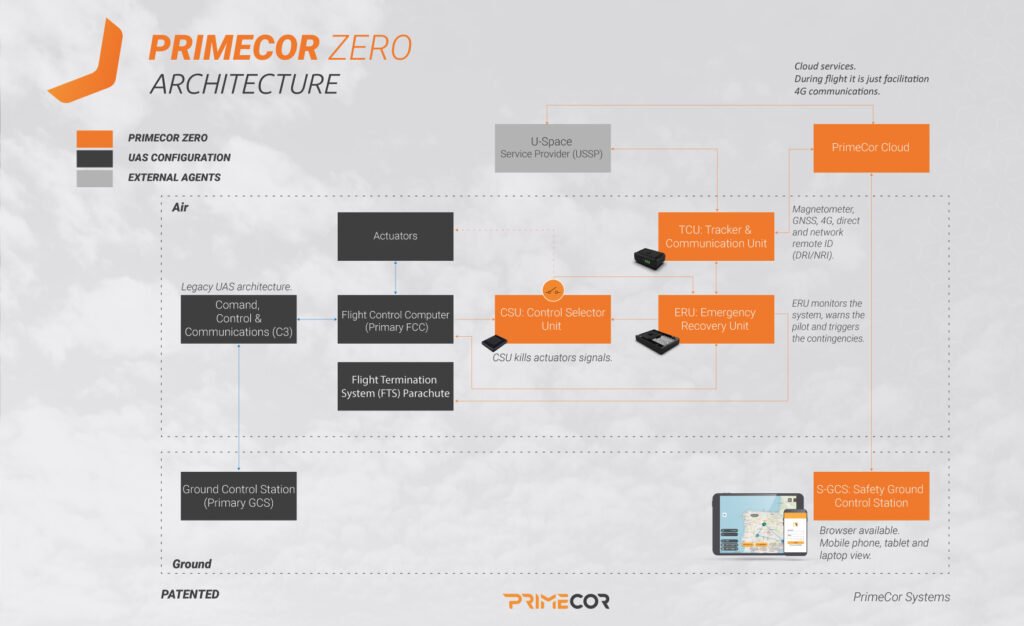
PrimeCor Zero is the embedded safety system developed by PrimeCor Systems that enables manufacturers and operators to achieve C5 or C6 class marking on their existing drones, without modifying the core flight platform. In short, you can convert your existing C3 drone with an add-on like PrimeCor Zero.
The kit consists of three hardware modules that integrate onto any MAVLink-compatible UAS:
TCU (Tracker & Communication Unit): handles DRI and NRI remote identification, GNSS positioning, flight data logging and communication with the PrimeCor Cloud platform. Weighs under 50 grams.
ERU (Emergency Recovery Unit): the brain of the system. Monitors the drone’s status in real time, detects anomalies, alerts the pilot and activates the required emergency procedures — including FTS activation — either autonomously or on operator command. Features dual IMU, barometer and magnetometer. Weighs 60 grams.
CSU (Control Selector Unit): hardware safety switch that cuts actuator signals independently of the primary flight controller. This is the component that physically implements the Flight Termination System. Weighs 17 grams.
Total kit weight is under 130 grams, with minimal impact on available payload. And it covers, in full, the conformity requirements that define a C5 or C6 class-marked drone.
The plug-and-play architecture is designed specifically to reduce the time and cost of the certification process. For the manufacturer, it means avoiding hardware redesigns. For the operator converting an existing fleet, it means recovering operational capability under European standard scenarios in the shortest possible time.
C5 and C6 marking: not just compliance, but market access
Beyond immediate regulatory compliance, C5 and C6 class marking carries strategic value that extends well beyond any single country. Unlike national standard scenarios — which were valid only within the territory where they were issued — STS-01 and STS-02 are recognised across all EASA member states. An operator with C5 or C6 class-marked drones can declare operations under these scenarios in Germany, France, Italy or any other EU member state without adapting documentation or fleet.
In a context where infrastructure, logistics, energy and security contracts are increasingly transnational, European class marking is also a passport to international project opportunities.
Is your fleet ready for European standard scenarios?
If you have aircraft that previously operated under national standard scenarios and need to define a transition strategy to achieve C5 or C6 marking, our technical team can assess your platform and evaluate the integration feasibility of PrimeCor Zero.
Talk to our team: sales@primecorsys.com
Regulatory source note: The C5 and C6 technical requirements described in this article are based on Commission Delegated Regulation (EU) 2019/945 and its amendment (EU) 2020/1058, and on Commission Implementing Regulation (EU) 2019/947 and its amendment (EU) 2020/639. For the complete and legally binding technical requirements, refer to the official text of these regulations and the Easy Access Rules for Unmanned Aircraft Systems published by EASA.
Lorem ipsum dolor sit amet, consectetur adipiscing elit. Ut elit tellus, luctus nec ullamcorper mattis, pulvinar dapibus leo.